

This week our currency strategists focused on the U.K. CPI Report (April 2025) for potential high-quality setups in the British pound.
Out of the four scenario/price outlook discussions this week, one discussion arguably saw both fundie & technical conditions triggered to become a potential candidate for a trade & risk management overlay.
Watchlists are price outlook & strategy discussions supported by both fundamental & technical analysis, a crucial step towards creating a high quality discretionary trade idea before working on a risk & trade management plan.
If you’d like to follow our “Watchlist” picks right when they are published throughout the week, you can subscribe to BabyPips Premium.
Check out our review on that discussion to see what happened!
GBP/NZD: Tuesday – May 20, 2025
GBP/NZD: 1-Hour Forex Chart by TradingView
On Tuesday, our strategists had their sights set on the U.K. CPI Report (April 2025) and its potential impact on the British pound.
Based on our Event Guide, expectations were for headline CPI to jump to 3.3% y/y from 2.6% previous, with core CPI forecast to rise to 3.5% y/y from 3.4%. With those expectations in mind, here’s what we were thinking:
The “Sterling Surge” Scenario:
If the CPI came in hotter than expected, we anticipated this could tilt the odds further away from BOE easing, especially after the less dovish MPC vote in their latest meeting. We focused on GBP/NZD for potential long strategies if risk sentiment stayed positive, particularly given the Kiwi’s vulnerability to global trade tensions and the pair’s symmetrical triangle consolidation pattern.
In a risk-off environment, EUR/GBP short looked promising for a triangle breakdown below the .8400 major psychological level, given the EU’s ongoing trade uncertainties with the U.S.
The “Sterling Slump” Scenario:
If U.K. inflation data disappointed or came in line with already elevated expectations, we thought this could trigger profit-taking in sterling positions. We considered GBP/JPY for potential short strategies in a risk-off environment, particularly targeting a move toward the 193.00 level which lined up with the 61.8% Fibonacci retracement.
If risk sentiment leaned positive, GBP/CAD short made sense given potential moves toward the 1.8600 support zone where trend line support and previous resistance converged.
What Actually Happened
The U.K. CPI report came in hotter than expected across all key measures:
- Headline CPI surged to 3.5% y/y (vs. 3.3% forecast; 2.6% previous)
- Monthly CPI jumped 1.2% m/m (vs. 1.0% forecast; 0.3% previous)
- Core CPI accelerated to 3.8% y/y (vs. 3.5% forecast; 3.4% previous)
- Retail Price Index spiked to 4.5% y/y (vs. 4.1% forecast; 3.2% previous)
Key drivers of the inflation spike included:
- Energy bills rising after Ofgem lifted its price cap by 6.4%
- Water bills climbing by 26%
- Higher National Insurance Contributions following Chancellor Reeves’ budget
- Increased communication costs, vehicle excise duty adjustments, and council tax hikes
Market Reaction
This outcome fundamentally triggered our GBP bullish scenarios, and with the broader risk environment showing cautiousness due to U.S. fiscal concerns and continuing trade uncertainty, GBP/NZD became our pair to watch.
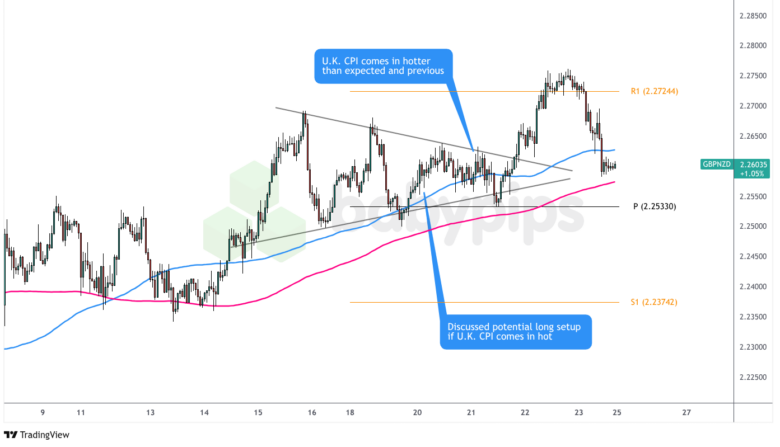
Looking at the GBP/NZD chart, we can see the pair had been consolidating in a symmetrical triangle pattern before the data release. The hotter-than-expected CPI data sparked momentary bullishness, but the gains were capped at the “falling highs” pattern. It’s likely the rally faced headwinds as traders quickly booked profits amid the broader “sell America” sentiment that was weighing on risk assets, likely keeping GBP/NZD consolidated on Wednesday.
On Thursday, NZD sellers continued to step in, likely a combination of broad market risk aversion vibes from U.S. fiscal concerns, as well as early week rate cuts from regional economies (China and Australia), leading to an upside break of the symmetrical triangle that likely drew in some technical buyers to the pair and pushing a bit past the R1 Pivot resistance area before topping out.
On Friday, GBP/NZD reversed back to the downside, largely ignoring a better-than-expected retail sales read from the U.K. U.S. dollar weakness was driving a lot of broad market price action, and it looks like it benefitted the comdolls more than the British pound, which may have been some end of week profit taking on NZD shorts as well.
The Verdict
So, how did it all play out?
We think this discussion was “likely” supportive of a net positive outcome as both fundamental and technical triggers aligned well. The hotter U.K. inflation data provided the fundamental conviction for a bullish lean, while the technical catalyst of triangle breakout did play out, preceding a momentum move to the upside. But the sustainability of the move was affected by broader market themes including U.S. fiscal concerns and escalating trade tensions.
If traders entered long positions on the triangle breakout and targeted the R1 pivot level, they could have captured a decent move initially. However, proper trade management would have been crucial given the choppy price action and eventual pullback from the resistance levels by Friday’s close.
So the ultimate outcome would have depended heavily on the trade plan and execution, which is why we rated this discussion as “likely” rather than “highly likely” supportive of a net positive outcome.

